
LNDT Starts the 86th Season With the Slogan ”We Cannot Be Without One Another”
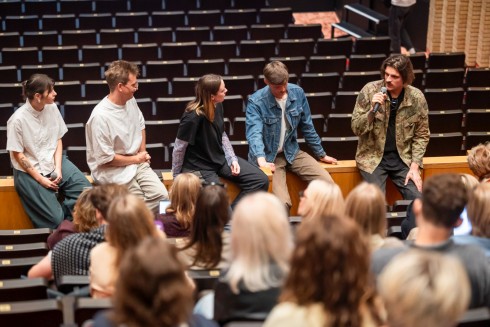
The presentation of LNDT's 86th season. Photo by Ekaterina Khvashchynskaya.
The Lithuanian National Drama Theater has launched its new season under the slogan "We Cannot Be Without One Another." This advertising campaign is being created by the "Rūt" agency in collaboration with illustrator Mykolas Saulytis. The visual campaign for the season and the posters for all premieres, which stand out for their original typefaces, are based exclusively on typographic solutions.
Do Not Go With the Flow Together With Conflict
At the season premiere event, LNDT Artistic Directors Kamilė Gudmonaitė, Antanas Obcarskas, and Eglė Švedkauskaitė shared their thoughts on what the slogan “We Cannot Be Without One Another” means to them personally.

Kamilė Gudmonaitė: "As the younger generation, we are forced to participate in certain conflicts; pitted against the older generation, we must fight back and arm ourselves. And in the context of the global conflicts and wars taking place around us, I find myself wondering how we can come together. Is it only possible through conflict? Bearing in mind that disagreement is also a form of encounter. How can we disagree without killing one another or starting wars? This slogan emerged during a discussion about what we wanted to address this season. It is precisely this being together, in community, and this invitation to come together that constitutes the greatest resistance to the war raging in the world. We invite you to experience two different, conflicting positions in one place, to make space for differences. Every production in the 86th season explores polarities and disagreements, and affirms that we cannot be without one another. This is the greatest insight we have gained during our two and a half years working at the LNDT."

Eglė Švedkauskaitė: "It is worth mentioning that this is a slightly abridged quote from the book "Ronia, the Robber’s Daughter". These words are spoken by two children who belong to different groups of robbers; their parents are in conflic with one another, but their children become friends. To me, these words are about the ability not to go with the flow together with conflict, but to find an authentic connection with the person you meet and to choose for yourself - whether you want to be friends with them or in conflict with them. Besides, no matter how difficult it may be, I cannot create a play without the actors, and they cannot do it without me. It is about the connection between people who experience great tension in their work but understand that without conflict, without a shared contribution, theater does not happen. That slogan calls for shifting the focus away from individuals who think they can create a play on their own. It has never been that way in theater, and it never will be."

Antanas Obcarskas: "For me, the slogan for the 86th season is about encounters, whether pleasant or not. I was very pleased when we all agreed by consensus that this was the most important slogan. Because when I look at the theater community and at society, and I see conflict, I realize that it is part of our inability to exist without one another. I realize that there is a lot I cannot be without. Without rehearsals, performances, actors, and the people around us. The way we manage things here, in the theater community, can serve as a small example of how to manage things in society at large. Because I know very well who, in this complex geopolitical context, could very easily be without us, and did so for a while, but now we are here, we must be here, even if we do not like one another - we must stay with one another."
LNDT Will Present Five Premieres
In the new season, LNDT will present five premieres exploring generational issues. The season will open on 6 and 7 September with the play for families, "Ronia, the Robber’s Daughter." One of Astrid Lindgren’s most popular novellas will be adapted for the Lithuanian National Drama Theater’s Main Stage for the first time. It is a story about choosing between what is expected of you and what your heart desires. By leaving her father’s castle, Ronja chooses the difficult path of maturing, but her courage is so inspiring that it helps even the fiercest enemies find common ground.
"I believe that the lessons conveyed in Astrid Lindgren’s work are incredibly relevant and important nowadays. Our production of "Ronia, the Robber’s Daughter" is a musical, witty, and profound coming-of-age story," says Eglė Švedkauskaitė, the play’s director and author of the dramatic adaptation.
The second premiere is Naubertas Jasinskas’ play "The Devil’s Bride," inspired by Arūnas Žebriūnas’ film, the life story of actress Vaiva Mainelytė, John Cassavetes’ intimate cinematic language, and Kazys Boruta’s short story "Baltaragio Malūnas," weaves a narrative about the influence of collective myths on our identities.

Naubertas Jasinskas says he is creating an entirely new interpretation of "The Devil’s Bride": "This will not be a new staging of Boruta’s play or a film adaptation with young actors. This production raises the question: Is reconstruction a form of love for the past, or an inability to create and exist in the present? The work is relevant today because we live in a culture obsessed with reconstructions, thereby fostering a dangerous relationship with memory. The desire to restore, recreate, and return becomes a safe zone where one can avoid real questions about the present." This is a highly anticipated co-production with the MMLAB Theater, which brings together intriguing artists and experiments with cross-genre productions. The premiere of the play will take place at the LNDT’s New Stage on 13–15 November.

Halfway through the season, in February 2026, the New Stage will host the premiere of Laura Kutkaitė’s play, currently titled "Teach Me". The director’s work is well known to audiences at the Lithuanian National Drama Theater, and this time she invites them to a docu-fiction play about an educational system that resembles a factory. School is an experience familiar to everyone, and Laura Kutkaitė will explore it by questioning authority with an inquisitive eye that does not shy away from humor.

According to the artistic directors, the Main Stage will be taken over in April by theater muses, ghosts, and utopias. The story behind this legendary production will be told by Karolis Kaupinis, a film director and screenwriter making his debut at the LNDT. In November 2024, his play "Obituaries of Lithuanians: The Story of a Single Play”, which was read at the "Versmė" festival, garnered significant audience interest and will be staged next spring. The play depicts a group of theater artists attempting to recreate a legendary play, thereby restoring a sense of wholeness to their own lives and to the present state of the theater. According to the director, the central idea of this play is that, in these unstable times, the only sustainable hope lies in the belief that everything does not end here and now. And the transience of this world is redeemed by the eternity of the next.

The 86th season of the LNDT will conclude in May with the premiere of a play by Chilean director Marco Layera, inspired by the stories of people returning to their homeland after years of emigration and presented under the working title "Desire". How do the places we leave behind change, and how do we ourselves change when we return later? The director seeks to reflect on the search for an ideal place in the world and the illusion that a safe haven is possible somewhere we are not. In recent years, Marco Layera has been actively creating at various theaters in Germany; his productions are gaining increasing recognition in Europe and have also been presented at the Avignon Festival.
The 20th "Versmė" Festival and Other Events
In November, the traditional "Versmė" festival, celebrating its 20th anniversary this year, will return to the Small Stage of the LNDT. This year, the contemporary drama festival will invite audiences to hear works by Italian playwrights, as well as to discover Kristina Steiblytė - the winner of the European Playwrights’ Residency Program, now in its third year - and her play about the relationship between humans and the forest.

Vaiva Grainytė and Eglė Murauskaitė, winners of the STAGES residency competition, will also present their collaborative work at "Versmė." Their work explores what the iconic LNDT foyer might become many years from now. Would visitors to the sanatorium, soldiers, or perhaps refugees gather around the "Versmė" sculpture?
For the second year in a row, the series of play readings "Readings: Drama Classics," which originated from an initiative by LNDT actors, will continue. The program features well-known classic works: Justinas Marcinkevičius’ "Mindaugas," a reprise of Friedrich Schiller’s "Mary Stuart," and Czesław Miłosz’s "The Power of Language." Another special reading will take place on November 9: "The Wave of Eternity," an event dedicated to the 150th anniversary of M. K. Čiurlionis’ birth, during which his letters to Sofija Kymantaitė and several literary texts will be read. Works for piano by M. K. Čiurlionis will be performed.
A statement from the LNDT's artistic directors about the season: https://www.teatras.lt/en/theatre-teatras/2024-2025-season/
Photos by Ekaterina Khvashchynskaya